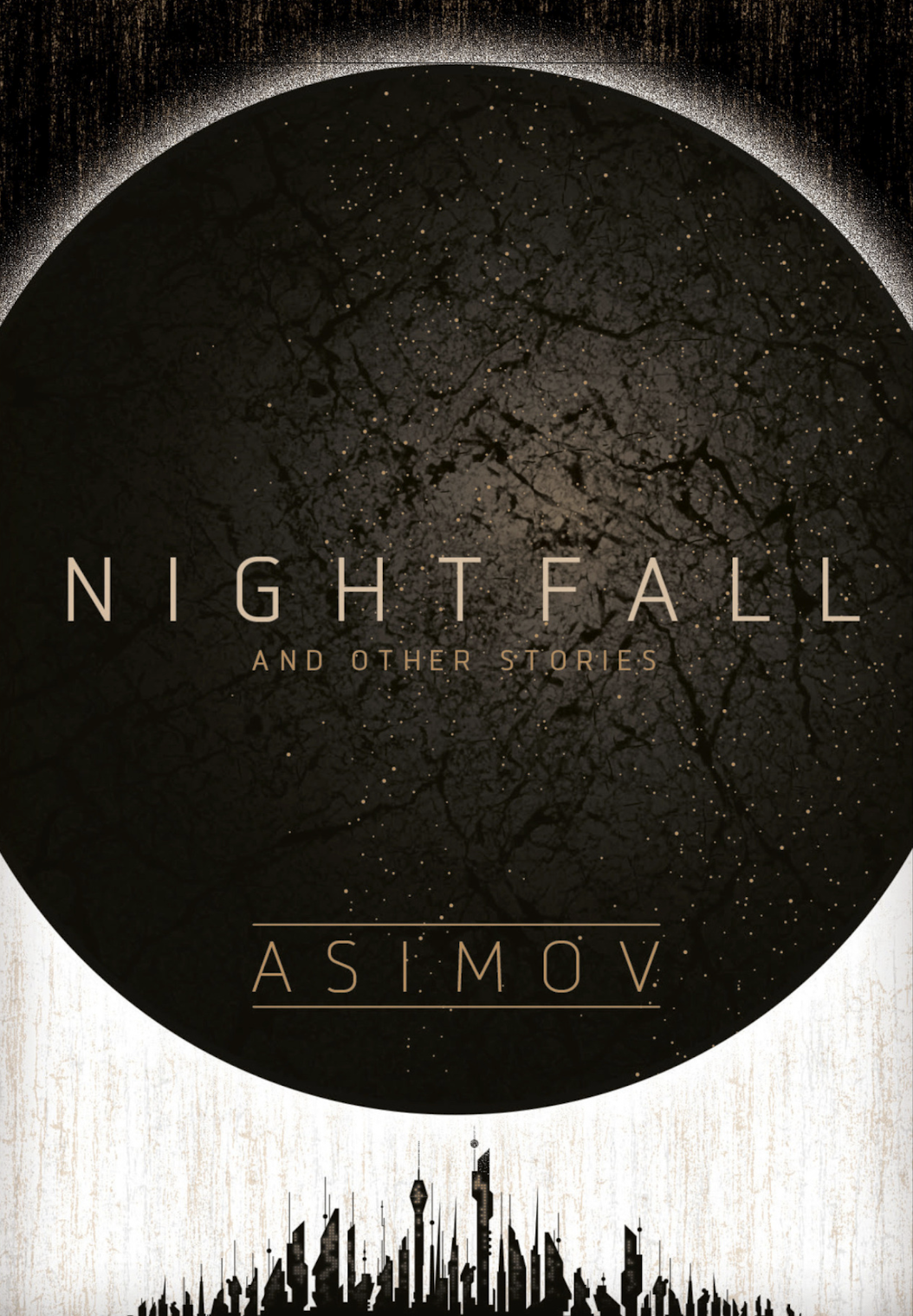
Nightfall and Other Stories. by Isaac Asimov. 1969
NIGHTFALL AND OTHER STORIES
RATED 78% POSITIVE. STORY SCORE 3.7 OF 5
20 STORIES : 5 GREAT / 9 GOOD / 3 AVERAGE / 1 POOR / 2 DNF
Nightfall and Other Stories is an important collection in the history of science fiction. I don’t think it has ever been out of print. It is an essential snapshot of the genre’s greatest figure - Isaac Asimov - and contains arguably the genre’s greatest story - Nightfall.
“So… Austin,” You might say, “What’s with the low score?” I could nitpick say that 78% isn’t actually a low score, but the more honest answer is this. Like Asimov’s writing style, the collection has some problems.
First the good stuff. Isaac Asimov is at his best when he is doing my ideal type of science fiction; testing a scientific hypothesis with storytelling. What would happen to a planet experiencing true darkness for the first time? What is the right way to influence politics? How would people react to never needing to go outside, etc? His characters are intelligent mouth pieces for interesting ideas. The vast majority of the stories in this collection are in this vein.
The bad stuff is his sense of humor, his prose when the ideas were weaker, and his female characters. Yes, he wrote some great female characters, but the average woman in a short story can’t be considered accurate or well-written. Having read his superb memoir - I, Asimov: A Memoir - this was an era in his life that Asimov didn’t understand or connect with women. He never really did, but a loving marriage in the second half of his life seems to have matured his literary femininity. Too many of the stories in this collection have romance at their center and that is a weakness of Asimov and drag on the overall quality of the collection.
Part of what makes this book so valuable is the commentary by Asimov himself and the backstories that accompany each story. I’ll quote a few of my favorites.
I must say, though, that as time passed, I began to feel some irritation at being told, over and over again, that “Nightfall” was my best story. It seemed to me, after all, that although I know no more about Writing now than I knew then, sheer practice should have made me more proficient, technically, with each year. The thing has preyed on my mind, in fact, until the idea of this book came to me. I have never included “Nightfall” in any of my own collections of stories because it always seemed to me to have been so well anthologized that it must be familiar to all my readers. Yet perhaps that’s not so. Most of my readers weren’t even born when the story first appeared and perhaps many of them haven’t seen the anthologies. Besides, if it’s my best story, then I want it in one of my own collections. I can also include other stories of mine that have proven successful in one way or another but have not appeared in any of my own collections.
…
I have said this before and I’ll say it again. I don’t know what is in my unconscious mind and I don’t care. I don’t even know for sure that I have one.
…
I am a compulsive writer. That means that my idea of a pleasant time is to go up to my attic, sit at my electric typewriter (as I am doing right now), and bang away, watching the words take shape like magic before my eyes. To minimize distractions, I keep the window-shades down at all times and work exclusively by artificial light. No one has any particular objection to this as long as we have the sleet of a typical New England late fall day darting through the air, or the blustering wind of a typical New England early spring day, or the leaden weight of Gulf air that splats out over New England in the summer, or the dancing flakes of that third foot of snow that blankets New England in the winter. Everyone says, “Boy, you’re lucky you don’t have to go out in that weather.” And I agree with them. But then comes a beautiful day in May–June or September–October and everyone says to me, “What are you doing indoors on a day like this, you creep?” Sometimes out of sheer indignation they pick me up and throw me out the window so I can enjoy the nice day.
Five Stories Join the All-Time Great List:
Nightfall • (1941) • novelette by Isaac Asimov. Great. One of the classics for a reason. In a world illuminated by the light of many suns, scientists believe that a coming eclipse will destroy the world and drive everyone mad.
"In a Good Cause—"? • (1951) • novelette by Isaac Asimov. Great. We open on the statue of a man who was three times arrested for his political beliefs and vision for humanity against an alien race. We then get to see each of these three moments and slowly learn the truth behind the statue. A powerful political message story that is also smart and propulsive.
Sally • (1953) • short story by Isaac Asimov. Great. He runs a farm for retired cars with positronic brains that drive themselves and seem alive. When a man arrives to steal their parts, things turn deadly.
It's Such a Beautiful Day • (1955) • novelette by Isaac Asimov. Great. This was the story that got me into science fiction in 2nd grade. I hadn’t revisited since then, but very glad that it still holds up. In a future upperclass American suburb, labor saving robots and devices made life sanitized. Doors teleport people from Door to Door. They never have to go outside — with the dirt and germs and weather and everything. One day, the Door breaks down and the son has to walk to school. Something changes within him and he doesn’t want to take the Door anymore.
Insert Knob A in Hole B • (1957) • short story by Isaac Asimov. Great. Very short short (350 words) and quite funny. Two men on a space station look forward to a robot that held with assembly for all the stuff that was sent to them unassembled.
NIGHTFALL AND OTHER STORIES: Complete Story Reviews
20 STORIES : 5 GREAT / 9 GOOD / 3 AVERAGE / 1 POOR / 2 DNF
Nightfall • (1941) • novelette by Isaac Asimov
Great. One of the classics for a reason. In a world illuminated by the light of many suns, scientist believe that a coming eclipse will destroy the world and drive everyone mad.
Green Patches • (1950) • short story by Isaac Asimov
Good. An alien that merges all life into one mind sneaks aboard a spaceship returning to Earth. The story alternates between the mind of the alien and the conversations of the human abord, who think they’ve survived.
Hostess • (1951) • novelette by Isaac Asimov
Good. Humanity is alone among species in that they die. A dinner party is strained
Breeds There a Man ... ? • (1951) • novelette by Isaac Asimov
Average. Overlong idea story about a scientist who thinks that humanity is an alien experiment and he is being driven to suicide to prevent him inventing a force shield that will project humanity.
The C-Chute • (1951) • novelette by Isaac Asimov
Good. Human prisoners of war on a human spaceship captured by aliens. They bicker amongst themselves until one man has an idea of a way to escape. That second have of the story is really well written and awe-inspiring in the sense of wonder.
"In a Good Cause—"? • (1951) • novelette by Isaac Asimov
Great. We open on the statue of a man who was three times arrested for his political beliefs and vision for humanity against an alien race. We then get to see each of these three moments and slowly learn the truth behind the statue. A powerful political message story that is also smart and propulsive.
What If—? • short story by Isaac Asimov (variant of What If ... 1952)
Average. A married couple who think they were fated to marry, meet a man on a train who shows them alternate possibilities.
Sally • (1953) • short story by Isaac Asimov
Great. He runs a farm for retired cars with positronic brains that drive themselves and seem alive. When a man arrives to steal their parts, things turn deadly.
Flies • (1953) • short story by Isaac Asimov
Poor. A silly short story that is also too long. A man is bugged by flies all his life and science eventually discovers why.
"Nobody Here But—"? • short story by Isaac Asimov (variant of Nobody Here But—? 1953)
Good. A romantic robot/ai story. A scientist’s love life is interfered with - and then saved - by the discovery that a robotic science experiment may have become sentient.
It's Such a Beautiful Day • (1955) • novelette by Isaac Asimov
Great. This was the story that got me into science fiction in 2nd grade. I hadn’t revisited since then, but very glad that it still holds up. In a future upperclass American suburb, labor saving robots and devices made life sanitized. Doors teleport people from Door to Door. They never have to go outside — with the dirt and germs and weather and everything. One day, the Door breaks down and the son has to walk to school. Something changes within him and he doesn’t want to take the Door anymore.
Strikebreaker • (1957) • short story by Isaac Asimov
Good. In a strict society, the wealthy outcast who manages the recycling of human waste goes on strike, risking the lives of everyone on the planet.
Insert Knob A in Hole B • (1957) • short story by Isaac Asimov
Great. Very short short (350 words) and quite funny. Two men on a space station look forward to a robot that held with assembly for all the stuff that was sent to them unassembled.
The Up-to-Date Sorcerer • (1958) • short story by Isaac Asimov
DNF. Asimov is never great with character and this “Gilbert and Sullivan” infused dialog is the very bottom of the character barrel.
Unto the Fourth Generation • (1959) • short story by Isaac Asimov
DNF. Asimov calls this is jewish story. It is just a guy getting stressed out by all the slight variations of a jewish last name. I don’t get it.
What Is This Thing Called Love? • (1961) • short story by Isaac Asimov
Good. One alien is trying to prove to another alien the impossible way that human’s reproduce. So it kidnaps a man and a woman and tries to convince them to have sex while relying on Playboy Sci-Fi Erotica as the educational text. Funny and stupid.
The Machine That Won the War • [Multivac] • (1961) • short story by Isaac Asimov
Good. The war against Deneb is over. It was won due to the power of the giant supercomputer Multivac. But as military, political, and scientific leaders take a moment of respite, they talk and realize that a technology far old was responsible.
My Son, the Physicist! • (1962) • short story by Isaac Asimov
Good. Never discount the wisdom of your mom, especially in matters of suspicious interplanetary communication
Eyes Do More Than See • (1965) • short story by Isaac Asimov
Good. Immensely old, non-corporeal beings start to recreate physical bodies and are overcome with emotion for what they’ve lost.
Segregationist • (1967) • short story by Isaac Asimov
Average. A doctor tries to talk a human out of replacing his failing human heart with a robot one.